Hello, welcome to Taizhou huangyan Anagte molding Co.,LTD.
language:  ∷
∷ 
∷ ∷ 
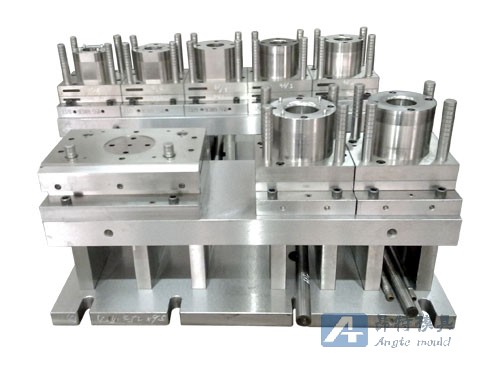
Human life, technological advancement and social progress all rely on products mass-produced with metal stamping dies. Metal stamping die industry permeates every facet of human life, ranging from large equipment such as automobiles, aircraft and spacecraft down to home appliances, construction materials and daily consumer goods, and it will continue to exert a profound influence on humanity in the long run.
China has become a major producer and consumer of molds, and the global mold manufacturing hub is shifting toward our country. Since China’s accession to the WTO, the mold industry, hailed as the "magnetic industry" by developed economies in Europe and America, has benefited from the transfer of manufacturing capacity from numerous foreign nations to China. The metal stamping die sector is therefore presented with unprecedented development opportunities.
The design and fabrication of integrated circuits in high-tech sectors depend entirely on precision progressive stamping dies for lead frames and precision IC plastic packaging molds. Precision plastic and metal stamping dies are indispensable for manufacturing computer casings, connectors and many electronic components. The development of digital electronic products (including communication devices) is equally impossible without high-precision molds.
Given the enormous scale of China’s mold industry, which segments account for the largest market shares?
Competition in China’s automobile and motorcycle market has become increasingly fierce. Vehicle models that have remained unchanged for over a decade or even several decades will be phased out. Apart from demanding better performance and superior configurations, consumers also have higher expectations for vehicle appearance. Automakers and motorcycle manufacturers must continuously launch new products and models to cater to consumer demand. Each car model requires thousands of molds worth over 100 million RMB, while each motorcycle model needs nearly a thousand molds valued at more than 10 million RMB. Moreover, approximately 80% of molds will be discarded when a car model undergoes a facelift.
Audio-visual products dominate this mold market, with color TV molds accounting for the largest share. More than 30 sets of molds are required to produce a single computer. Fueled by the rapid expansion of the communications industry, communication products are updated frequently, generating strong demand for supporting molds.
Currently, manufacturing one refrigerator requires around 350 molds with a total value of 4 million RMB; a fully automatic washing machine needs 200 molds worth 30 million RMB; and an air conditioner alone uses 20 plastic molds valued at 1.5 million RMB.
Plastic doors and windows, plastic drainage pipes, decorative plastic products, medical instruments, as well as kitchen and sanitary ware will witness robust growth over the next five years. By 2010, the market penetration rate of plastic doors, windows and plastic pipes will reach 30% to 50%, driving a sharp rise in mold demand. Mold manufacturers specializing in plastic pipe and door/window production enjoy promising development prospects and will face little negative impact following China’s WTO accession. It is evident that the mold industry has transformed from a secondary sector reliant on imports into an independent, emerging industry.
 WeChat scan code

support hotline+86-576-84628618

mobile phone13606824896
Add:No.3 Kangqiang road,Northern industry area ,Huangyan,taizhou,Zhejiang.China 浙ICP备11052107号 XML 网站模板